

Wires in a Box
I wanted my first blog post to be about a piece of technology or an integrated system we use at SNEAKY BIG Studios, but as I continued to write that first post, I kept coming back to one unifying thing, and that is people. Call them employees, freelancers, operators, engineers, etc., these people are what truly set apart any production, any facility, any event.
All of the equipment we are lucky enough to have and use here at SNEAKY BIG really can’t do anything by itself. They are just tools in our toolbox and like any tool, it takes truly skilled and creative people behind those tools to create amazing commercials, engaging animations and VR worlds, sports and event broadcasts, and much more go from concept to reality. Every production starts somewhere and for this post, that somewhere will be when we started building out the technical systems at SNEAKY BIG Studios.
On June 1st of 2016, I started my first day at SNEAKY BIG Studios. When I walked in the door the facility had only just been cleared for occupancy, and only a couple of days of equipment install had happened in the production facilities and Central Equipment Room. More than a year of planning, equipment research, and systems design had happened and now it was time to put all that planning into motion.
To say the first couple of months at SNEAKY BIG was like “drinking from a firehose” would be an understatement. We had some of the most advanced production equipment being made and in some cases equipment that we were among the first to install and commission. The Harmonic MediaGrid 4000 comes to mind here (Shared Media Storage). We’ll talk about that in a future post. Between the crews provided by Digital Glue, Broadcast Integration Services (BIS), SNEAKY BIG staff, and commissioning crews from different vendors, there were at any time 12-18 people in our facility working very long hours racking and wiring equipment, configuring systems, creating technical drawings, etc. for us to reach our deadline of August 10, 2016, the Grand Opening of SNEAKY BIG Studios.
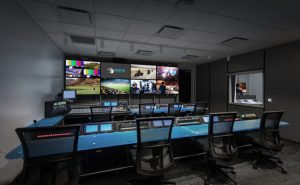
If you haven’t been part of a systems integration, it’s sometimes hard to truly understand the scope of what’s going on. Let’s take our Grass Valley NVISION video router as an example. This is just one sub-system, albeit a very important sub-system, in our facility. Our router is 288×576. That means it has 288 inputs and 576 outputs. Let’s assume that every cable attached to those inputs and outputs is 40 feet long (lengths vary depending upon where the equipment being connected resides). Some cables could be 10 feet long others could be 100 feet long). That means we used somewhere in the neighborhood of 34,560 feet of cable (6.55 miles) just connecting all the sources and destinations into and out of that router. Let’s also keep in mind that there are two ends of a cable. When you build out a facility on the scale of SNEAKY BIG, you don’t buy off the shelf pre-terminated cables. That means that the integration crew needed to terminate 1,728 connections – one on each side of the cable. We also needed to keep in mind that all of this cable had to be pulled through our facility to get to where the equipment resides. Some of the equipment could be one rack away and some could be on the other side of the building in an edit room or on a stage. Our division of labor was such that we had at least two installers working on the router termination and at some points two teams of installers (2–3 people per team) pulling the cable through the facility. Everything these installers and integration specialists did during the buildout and commissioning of the facility could have a great effect on the future working of that facility. A poorly terminated connection could cause issues later such as intermittent video dropout or transmission failure altogether. Nicked jackets on analog audio cable could cause interference on the audio line, and fiber-optic cable (which SNEAKY BIG has a ton of) that is pulled incorrectly could have been damaged or broken. These integrators took great care to make sure the cables were pulled safely, terminated properly, and organized in a very neat and orderly way.
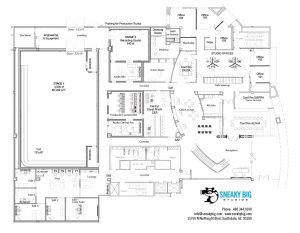
Another thing needed was documentation. Documentation is, in my opinion, the most important thing you need in any buildout. If you don’t have everything labeled and drawn up, how can you ever find and fix a problem when they arise or plan the addition of new equipment in the future? We put very detailed cable labels on each end of every cable in the facility be it Coax, single pair, CAT5e/6, fiber, etc. with unique identifying numbers, descriptions of where that cable comes from and where that cable ends up, and a note of what drawing that cable shows up on. We then documented that cable and every input, output, and connection in AutoCAD drawings of our facility. Right now, we have 189 drawings of our current buildout, broken down into each sub-system. The router alone has over 15 drawings and those drawings tie into almost every other drawing in the plant. When we came into the facility and started to build out, we had an initial set of drawings showing how, in a perfect world, everything would connect. As integrators and engineers, we’d love for those drawings to be perfect and for us to be able to follow them to the letter. We, of course, know that isn’t going to be the case. As we pulled, terminated, and commissioned equipment, we “marked up” these drawings in pencil to show changes we’d made and note the cable numbers on the drawings as we labeled cables. We then needed to go back in and modify these drawings from “concept drawings” to “as-built” drawings. That takes more people with specialized knowledge of AutoCAD and Vizio (we use Vizio to do quick concept drawings before we build the drawing the as-build in AutoCAD). In many cases, members of the team who pulled and terminated the cables were also talented CAD operators, and, after finishing a system, would note all the changes on the drawings for that day. Once the drawings were finished, we’d go back and check every wire and every system to make sure that the drawings accurately reflected our systems as a whole.
So, here we are, right where we started. I want to take a moment to say THANK YOU to the dedicated team of professionals who came into SNEAKY BIG Studios, worked incredibly long hours, under a very tight deadline, and helped build a truly amazing facility. Not a day goes by where I don’t think about working with you and your help in building SNEAKY BIG. It just goes to show that along with having amazing equipment, you need to have an amazing talent for installing and using that equipment. If you don’t, it’s just wires in a box.
We have an amazing, and growing team of talented and creative professionals working at SNEAKY BIG and are very lucky to be able to work with some of the most talented freelancers in Arizona and from around the country. From the first day we turned on the lights to the present day (two years and a few days from when I first walked in the door), I have seen amazing things happen by truly amazing people. I can’t wait to see what we do next!
In future posts, I’ll be writing about the technology we have at our disposal as well as the people who work on that equipment, but I want to make sure I’m writing about systems or tech of interest. Let me know in the comments what you want to read more about, and I’ll happily do my best to fill you in.