


What’s Missing From Today’s Tech-based Editing?
When I was starting out in Post-Production, there was a clearly defined road one took to becoming an editor. These were the last few years of cutting film on a 35mm flatbed and my experience was limited to the commercial world versus the TV or feature world, but there were basic similarities to the path one took. To begin, let’s jump forward to today.
What does an assistant editor do in today’s computer-based, digital editorial world? They have been relegated to the machine room or have become data wranglers. They rarely, if ever, are in the same room as the editor and certainly have very little involvement in the actual “editorial process.” This is 180 degrees from the way I came up and, in my opinion, it is creating a generation of editors who may know the tech but they don’t know the art and the craft of editing.
When I started at Ace & Edie, one of LA’s premiere commercial edit shops, back in the mid 80s, I had worked in production for five years. I knew nothing about Post and I started mostly syncing a lot of dailies. This was done on rewinds and was a labor-intensive process. However, you got your hands on the footage and you were the primary link in organizing the film.
Back then, I sound like an old fart, dailies were screened for the agency in a theater at one of the labs. A room full of people would watch ALL the footage and make comments on takes they liked, etc. and the assistant would take notes as fast as he/she could write. This was the second time, after syncing, that I got to view all the footage.
After the screening, the editor would put the dailies on the KEM and go through the material and mark selects. Then the assistant would pull the rolls apart and organize the footage in either the order of the storyboards or the standard WS, MS, CU order. This would be my third exposure to the material.
I had a unique situation at Ace & Edie. Most editors worked solo on an 8-plate flatbed that had four plates for footage and four plates for the cut. Not unlike having a source and record window today. The editor I assisted had two, 4-plate KEMS that would lock together. The editor would sit at one and the assistant would sit at the other and feed the editor film and clips that the editor would assemble on his KEM. Sometimes the editor controlled both; usually we worked side by side as a team.
I’m going to stop here for a minute and talk about the KEM or any flatbed machine.
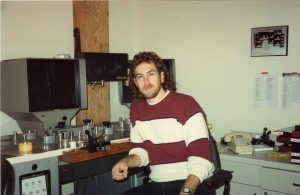
A two-year-old could operate it. It had three basic buttons: forward, stop and reverse with variations depending on the model. Pretty simple. The other part of the equation was the splicer. They came in two flavors: a guillotine splicer and a Revis splicer. We used the Revis. That was it. Boom! The tools of the trade. Not that much to it. We will come back around to this in a bit.
What do you see as the big differences here between the way I learned and the way things are done today? 1. The tool was superfluous and, 2. MOST important, editing primarily was about the “film” and “the creative process.” Job postings did not preface which brand of flatbed experience was required or whether you knew how to use a Revis splicer. It was about your creative talent. Period!
OK, back to the part about being an assistant.
The advantage and difference to those who came up as I did was we were in the room and, in most cases, directly handling the material. I got to sit right next to the editor and watch which shots he chose and why. I got to hear the discussions with the clients and I was directly involved with the editorial process. On top of that, since I had been working with this footage since dailies and had organized it into select rolls, I knew the footage better than the editor did. I knew which roll every stray single frame came out of and if the editor needed a CU of a particular actress, I knew where to find it among 24,000 feet of film.
What, besides the obvious, is the advantage of working like this? When the editor has to move onto another job and or revisions come down the line, who gets to make those changes? The assistant! He knows the footage, the editor’s style and direction and the politics involved with the ad agency clients. The clients get comfortable working with you and trust that you know what you are doing and know you will take care of them. The next time they want your editor and he is not available to guess who they will ask for? You. Kazam – you’re officially an “editor.”
OK, that might be a little simplistic and I left out a few stages for transitioning to full-fledged editor, like doing sound work and preparing and supervising finishing and several long months of ghost cutting with no increase in status or pay, but you get the gist here.
It was about learning. Learning the footage, learning the creative process, learning how to run a session. It had nothing to do with the ability to run software or the equipment. A KEM is a Steenbeck is a KEM. A splicer is a splicer. Done. You got it. It was about learning to think visually. Learning to think creatively. Learning to “EDIT”!
Don’t get me wrong; I never want to cut film again. I am not pining for days long gone. I LOVE working with today’s edit tools and all that they offer creatively. But my ability to use Avid or FCP or Premiere or the fact that I know After Effects hasn’t made me as successful as I have been over the last 20 plus years of my career. It was the discipline and the craft and the art that I learned by actually being involved in the process. When was the last time your assistant, if you even have one, sat next to you and just watched what you were doing? When was the last time you sat next to him or her and let them drive under your supervision? There used to be a path one followed and the path was laid out for a very good reason. That path has disappeared and that is sad.